This is part I in a multi-part series exploring the youth and adolescence of Robert Stanton, former Director of the National Park Service and the first director of color, and how the context of his early years informed his tenure atop the NPS. You can find part II here, part III here, part IV here, and part V here.
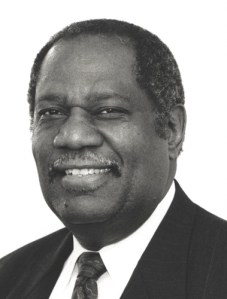
The earthy smell of livestock and fresh-tilled soil hung thick in the air. Large oak trees, singing birds, and chirping crickets populated any land that hadn’t been cleared for farming. Men and women worked the fields, cutting and baling hay or picking cotton. The streets were dusty and unpaved and unlighted. Small log cabins that housed big families lacked the luxuries of electricity or plumbing.[1] It was in this environment that Robert “Bob” Stanton was born and long felt at home.
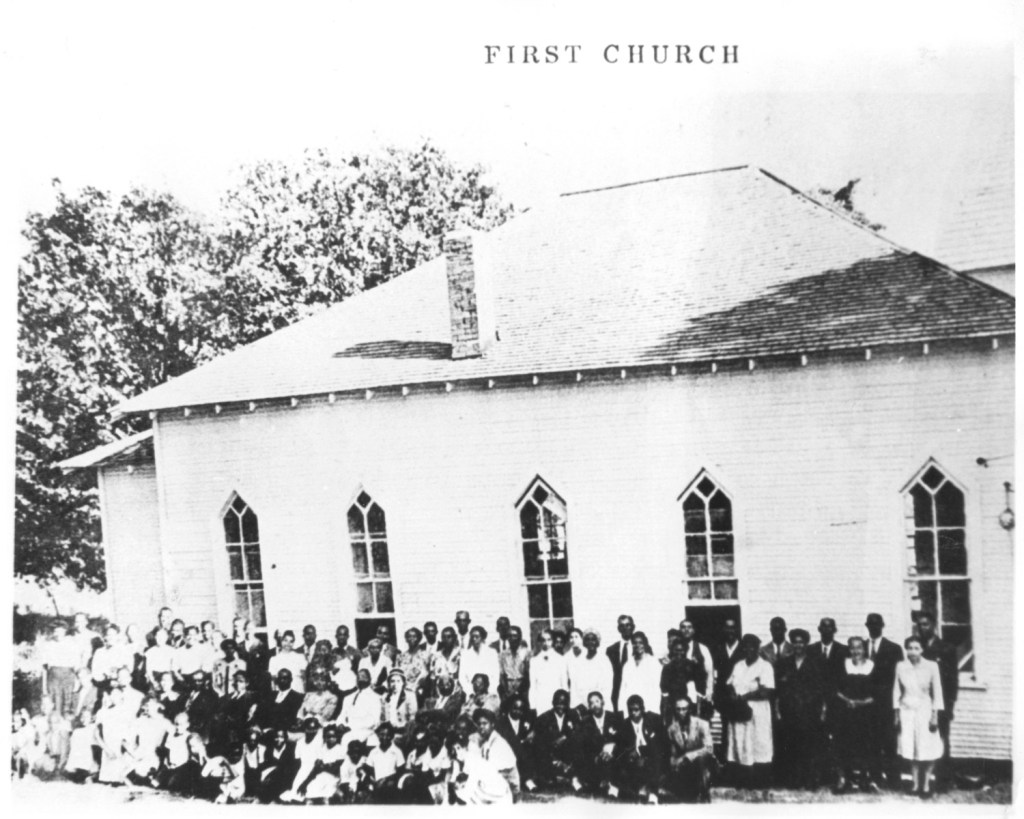
Alvin Herbert Stanton and Bethel Lee Stanton (née Blackburn) welcomed their son Bob into the world on September 22, 1940 in Fort Worth, TX. Stanton grew up in Mosier Valley, the earliest freedmen’s community founded in Tarrant County on the north bank of the Trinity River in the early 1870s. It was a “very close-knit community” where people rarely went anywhere beyond three small churches, a couple of jukebox cafes, and a small two-room wood-framed schoolhouse.[2]
Stanton enjoyed spending time with friends, cousins, nieces, nephews, aunts, and uncles. Two of his three older siblings were more than a decade his senior, so their kids — his nieces and nephews — were more like brothers and sisters than his actual siblings.[3] Sense of family was a pillar of the Mosier Valley community, one shared by many Black communities founded in the Reconstruction era South. Intertwined with family at the center of Black social life was the church.[4] Stanton’s childhood reflected this dynamic. He was active in the St. John Baptist Church and, decades later, said he wanted to be remembered as someone “who did not dishonor my parents, my family, and certainly my ancestors.”[5] Family and community were sources of love, stability, and protection, and measures of one’s moral values.
Mosier Valley had been a farming community since its founding and little changed between then and Stanton’s early childhood. The population consistently hovered around 300 residents, give or take a few. Farmers harvested cotton and corn, planted sustenance gardens, and raised livestock.[6] A reverend who came to pastor at the St. John Baptist Church remembered Mosier Valley as “really kind [of] productive cause they raised stuff born on the land.”[7] Stanton’s father Alvin was a hay bale contractor and, time permitting, raised cotton and other crops. Alvin was “his own businessman.”[8]
Alvin was born in Dallas County on April 14, 1906. He was probably raised by his uncle and aunt William and Lizzie Boles and Stanton never knew his paternal grandparents.[9] With limited formal schooling, Alvin found work as a farmer and laborer, and at a young age he also found love.[10] Alvin and Bethel Blackburn married on December 23, 1922 in Dallas County. They were both just 16 years old.[11] “They could have met in the fields… either chopping cotton or picking cotton,” but Stanton never knew for sure the circumstances that brought his parents together. Alvin was enterprising and tireless, “worldly wise,” and “a very strong family provider.”[12] When Alvin died unexpectedly in 1959, just before Stanton entered college as a freshman, tremendous financial strain befell the family.[13]
Bethel eked out a living as a short-order cook wherever she could find work in the communities around Mosier Valley. Like her husband, Bethel’s juvenescence was spent chopping and picking cotton and tending to cattle, hogs, and other livestock before embarking as teenager on a youthful marriage. She was an avid churchgoer, loved her siblings (she was the second of eleven children), and “talked about the importance of a family being strong and caring for each other.” Stanton, painting juxtaposing portraits of his parents, described his father as strong and streetwise and his mother as “a giant of a lady and very warm, very caring.”[14]
Unlike Alvin, Bethel knew her family lineage and may have told stories to her son Bob of his deeply rooted heritage in Mosier Valley. Stanton knew his maternal grandmother, Delilah Blackburn (sometimes Delila in historical records). Born in 1881, Delilah was a devout Christian who owned a small plot of land with an orchard that bore peaches and pears in the summer and early fall. As kids, Stanton and his relatives snuck around the orchard stealing fruit for fun but the good-natured Delilah was ever forgiving.[15]
Stanton said his mother was descended from freed slaves named Robert and Dilsie Johnson, two of the original founders and landowners of Mosier Valley, through Delilah’s side of the family. Delilah’s parents were Sallie and Robert Johnson, Jr.
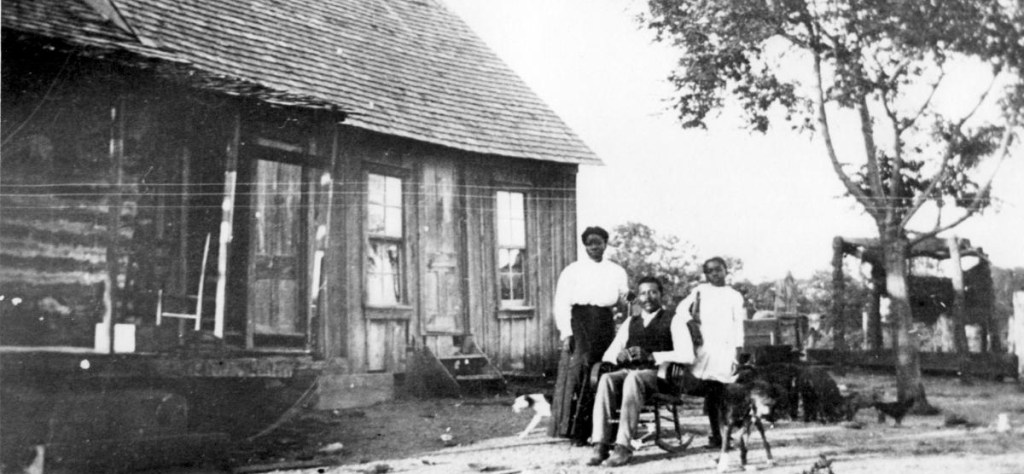
Robert Jr. was born in Texas in 1865, though his parents were likely from Tennessee.[16] Delilah’s husband, Anderson, was born in Mosier Valley in 1877 to Zack (or Jack) and Jennie (or Tennie) Blackburn. Though Zack appears to have been born in Missouri, his parents Anderson and Nancy were also born in Tennessee.[17] Indeed, Mosier Valley was founded by enslaved people who mostly originated from Tennessee, taken to Texas by way of Missouri to the J.K. or T.W. Mosier plantations.[18]
It was typical for members of large families in towns like Mosier Valley to live in close proximity to one another. For example, Mosier Valley resident Beatrice Parker Green, born in 1907, was one of twelve children, seven boys and five girls; her own father was the oldest of ten and he left home after marriage but “they still lived… here in Mosier Valley.” She had relationships with all her aunts and uncles growing up. Not only was her family tight but so too was the entire town. Green “knew everybody in Mosier Valley.” And she knew the land. Acreage owned and farmed by her father was passed down through generations. Her grandfather married a woman who was gifted land by former slaves. He then doled out parcels to family “to have a place to live, farm, and to also build.”[19]
Like Stanton’s father Alvin, Green had a limited formal education. Like Green, Stanton knew many of his peers. Some 50 or 60 classmates would’ve joined Stanton in the Mosier Valley Elementary schoolyard and a good portion of them were just as likely to be family relatives as family friends.[20]
Stanton was a good student and enjoyed learning as much as he could. It was not often but not uncommon for Stanton to spend the first half of the day in school and the second half working the fields with his father. Despite this, his attendance record was near perfect if not precisely so. He had a deep admiration for his teachers and they gave him what he described as “the best training” of his early childhood.[21]
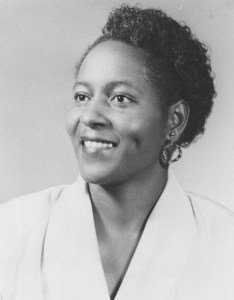
The Mosier Valley schoolteachers were dedicated instructors who did their best to provide a reliable education to the community’s youth, perhaps sharing in the idea that “access to education… for blacks [was] central to the meaning of freedom.” In turn, Stanton was obedient and respectful and rarely required disciplinary action. One of Stanton’s favorite teachers, Miss Vada Johnson was also a descendant of Robert and Dilsie Johnson, the original settlers of Mosier Valley, which meant she was also a distant relative of his. 1
Miss Johnson was “dedicated” and provided “quality instruction” for first graders through eighth graders . Her commitment to the local kids included tough love for Stanton. In one rare instance in third or fourth grade, he was reprimanded by Miss Johnson. Fair and expectant, Miss Johnson was one of the few adults in Mosier Valley who attended college. She cut a positive example for the eager Stanton and made a positive impact on him, so much so that he remembered her fondly decades later.[22]
Though his family was not wealthy, they shared an abundance of good times. Holiday cheer was plentiful during Thanksgiving and Christmas even if material gifts were not. Family gathered around a bountiful dinner table topped with turkeys and chickens, and times “high in spirit and family togetherness” ensued, which, despite being a family of “low economic means,” “made it very rich” for the Stantons.[23]
Stanton’s childhood was family-oriented with an intimate but deep community network situated within a prejudiced agrarian political economy. Mosier Valley was a hardscrabble town where education was valued but came second to labor when extra hands were needed. Times were simultaneously harsh and enjoyable. Hard work was a fact of life. So too was inequality.
“Segregation was still the law of the land,” so Stanton’s entire youth in Texas “was in a segregated set of circumstances.”[24] Regardless of the good times in school, or the laughs shared with friends around the jukebox, or the comings and goings of extended family members, or the congregation’s bustling social calendar, Stanton was raised under the insidious veil of Jim Crow.
Even if there wasn’t an explicit Black-white dichotomy in the predominantly Black Mosier Valley, one existed across town, county, and school district lines. Local politics and socio-economics were dyed in the color of discrimination, bleeding into residents’ quality of life and delivering little in the way of infrastructure, utilities, or educational resources. Residents, though, were determined to better their own circumstances.
Since emancipation, education was an important vehicle for improving the conditions of lives of freed people and people of color.[25] That historic gravity may have weighed heavily when a group of Mosier Valley parents demonstrated for improvements to their dilapidated elementary school in 1950 by demanding enrollment of their children at the all-white school in neighboring Euless, TX.
Opposition forces were certainly at play when segregation was ruled unconstitutional in 1954: white Southerners saw integration in public schools as a threat to the foundation of white supremacy, which “was constructed upon destructive stereotypes of black intellectual inferiority and fears of black male sexuality.”[26] This prejudice turned violent in 1957 when a segregationist mob confronted nine Arkansas children, attempting to stop their attendance at Little Rock Central High School. The events of 1950, 1954, and 1957, in addition to the premature death of his older brother in 1951, would have an enduring effect on Stanton, remaining with him later on as he steered the course of the National Park Service.
[1] On sounds and smells, see: Stanton, Robert G. Interviewed by Racine Tucker Hamilton, August 11, 2004, in Washington, DC. The HistoryMakers Digital Archive. Session 2, tape 1, story 9.
https://da-thehistorymakers-org.silk.library.umass.edu/story/203367. On state of housing, see: Beatrice Parker Green, interviewed by Dan Clark, October 18, 2006, in Euless, Texas, transcript, Euless Historical Preservation Committee, https://www.eulesstx.gov/community/history/oral-history-narratives/beatrice-parker-green.
[2] Stanton, interviewed by Hamilton, Session 2, tape 3, story 1.
[3] His closest sibling in age, Alvin Joyce Stanton, was two years older than him. His two oldest siblings, sister Ora Lee and brother Franklin “Frank” Taylor, were fifteen and fourteen years older than him, respectively. (See: 1940 census: U.S. Census Bureau. Population Schedule, 1940. Prepared by AncestryLibrary. https://www.ancestrylibrary.com/imageviewer/collections/2442/images/m-t0627-04142-00101?usePUB=true&_phsrc=Oit1571&_phstart=successSource&usePUBJs=true&pId=157920198;) On Mosier Valley Elementary, see: Robert G. Stanton, interviewed by Racine Tucker Hamilton, August 11, 2004, in Washington, DC, The HistoryMakers Digital Archive. Session 2, tape 1, story 10.
[4] Eric Foner, A Short History of Reconstruction, 1863-1877, New York, NY, Harper & Row, 1990, 40.
[5] Robert Stanton, interviewed by Racine Tucker Hamilton, August 11, 2004, in Washington, DC, The HistoryMakers Digital Archive. Session 2, tape 4, story 3. https://da-thehistorymakers-org.silk.library.umass.edu/story/203391.
[6] George N. Green, “Mosier Valley, TX.” Texas State Historical Association Handbook of Texas, December 8, 2020. https://www.tshaonline.org/handbook/entries/mosier-valley-tx.
[7] Lloyd G. Austin, interview by Chris Jones, December 11, 2006, transcript, Euless Historical Preservation Committee, https://www.eulesstx.gov/community/history/oral-history-narratives/reverend-lloyd-g-austin.
[8] Robert G. Stanton, interviewed by Racine Tucker Hamilton, August 11, 2004, in Washington, DC. The HistoryMakers Digital Archive, Session 2, tape 1, story 4, https://da-thehistorymakers-org.silk.library.umass.edu/story/203362.
[9] Alvin is listed as part of the Boles household on the 1910 and 1920 US Census, aged four and fourteen, respectively U.S. Census Bureau (See: 1910 Population. Prepared by AncestryLibrary. https://www.ancestrylibrary.com/imageviewer/collections/7884/images/4449281_00621?usePUB=true&usePUBJs=true&pId=27898064; 1920: U.S. Census Bureau. 1910 Population. Prepared by AncestryLibrary. https://www.ancestrylibrary.com/imageviewer/collections/6061/images/4392014_01145?usePUB=true&usePUBJs=true&pId=108113006.). Stanton did once refer to a “lady who raised my father (See: Robert G. Stanton, interviewed by Racine Tucker Hamilton, August 11, 2004, The HistoryMakers Digital Archive. Session 2, tape 1, story 5, https://da-thehistorymakers-org.silk.library.umass.edu/story/203363.)
[10] The 1940 US Census indicates the highest grade he completed was fifth grade. (See: U.S. Census Bureau. Population Schedule, 1940.)
[11] State of Texas, Select County Marriage Records, Alvin Stanton and Bethel Blackburn, December 23, 1922, 254, https://www.ancestrylibrary.com/imageviewer/collections/9168/images/49068_b581097-00163?usePUB=true&usePUBJs=true&pId=131093292.
[12] Stanton, interviewed by Hamilton, Session 2, tape 1, story 4.
[13] Alvin Stanton died on August 26, 1959 in Amarillo, TX. According to newspaper reports, a man named Tilford Higgins told police Alvin came to his house and started in physical altercation. Higgins alleged Alvin swung at him twice with an ice pick. Higgins then said he struck Alvin with a blunt dagger. Alvin died of severe bleeding due to wounds to his chest and neck. (See: Death certificate: State of Texas Department of Health, Certificate of Death, Alvin Stanton, August 28, 1959, https://www.ancestrylibrary.com/imageviewer/collections/2272/images/40394_b062551-02636?usePUB=true&usePUBJs=true&pId=23896684; and News clippings: “Stab Wound Fatal to Man,” Amarillo Daily News, Amarillo, TX, August 27, 1959; “Police Check Fatal Stabbing,” Amarillo Globe-Times, Amarillo, TX, August 27, 1959.)
[14] Robert G. Stanton, interviewed by Racine Tucker Hamilton, August 11, 2004, in Washington, DC. The HistoryMakers Digital Archive. Session 2, tape 1, story 3. https://da-thehistorymakers-org.silk.library.umass.edu/story/203362.
[15] Stanton, interviewed by Hamilton, Session 2, tape 1, story 5.
[16] U.S. Census Bureau, Schedule No. 1 – Population. 1910, Prepared by AncestryLibrary, https://www.ancestrylibrary.com/discoveryui-content/view/157920198:2442?_phsrc=Oit1571&_phstart=successSource&_phtarg=Oit1568&gsfn=Alvin+Herbert&gsln=Stanton&ml_rpos=1&queryId=32fd2021482d4f26efa846a2f0ec7635.
[17] Texas Department of Health Bureau of Vital Statistics, Standard Certificate of Death, Anderson Taylor Blackburn, December 1, 1943, Prepared by AncestryLibrary. https://www.ancestrylibrary.com/imageviewer/collections/2272/images/40394_b062245-03299?usePUB=true&usePUBJs=true&pId=22217754; U.S. Census Bureau. 1870 United States Federal Census. Prepared by AncestryLibrary. https://www.ancestrylibrary.com/imageviewer/collections/7163/images/4267896_00603?usePUB=true&usePUBJs=true&pId=10999865; U.S. Census Bureau. 1880 United States Federal Census. Prepared by AncestryLibrary. https://www.ancestrylibrary.com/imageviewer/collections/6742/images/4244800-00326?usePUB=true&usePUBJs=true&pId=7287029.
[18] Green, “Mosier Valley, TX,” Handbook of Texas.
[19] Beatrice Parker Green, interviewed by Dan Clark, October 18, 2006, in Euless, Texas, transcript, Euless Historical Preservation Committee, https://www.eulesstx.gov/community/history/oral-history-narratives/beatrice-parker-green.
[20] Robert G. Stanton, interviewed by Racine Tucker Hamilton, August 11, 2004, in Washington, DC. The HistoryMakers Digital Archive. Session 2, tape 1, story 10. https://da-thehistorymakers-org.silk.library.umass.edu/story/203365.
[21] Stanton, interviewed by Hamilton, session 2, tape 1, story 7.
[22] Stanton, interviewed by Hamilton, session 2, tape 1, story 10.
[23] Robert G. Stanton, interviewed by Racine Tucker Hamilton, August 11, 2004, in Washington, DC. The HistoryMakers Digital Archive, session 2, tape 1, story 6. https://da-thehistorymakers-org.silk.library.umass.edu/story/203364.
[24] Stanton, interviewed by Hamilton, session 2, tape 1, story 7.
[25] Foner, Reconstruction, 34.
[26] Sonya Ramsey, “The Troubled History of American Education after the Brown Decision,” The American Historian. https://www.oah.org/tah/issues/2017/february/the-troubled-history-of-american-education-after-the-brown-decision/.
 The Sketch Book of Nick DeLuca
Leave a comment