This is part III in a multi-part series exploring the youth and adolescence of Robert Stanton, former Director of the National Park Service and the first director of color, and how the context of his early years informed his tenure atop the NPS. You can find part I here, part II here, part IV here, and part V here.

Not long after the parents of Mosier Valley demonstrated for better educational resources and facilities for their children, tragedy struck the Stanton home. It was the end of the summer, 1951.
Cpl. Franklin T. Stanton was 15-years older than his younger brother Bob, who affectionately called him Big Bubba. Frank was a veteran of WWII and in May 1950 he re-enlisted to fight in the Korean War.[1] He served as a member of Company C, 77th Engineer Combat Company, 24th Infantry Division. Frank was approaching his 26th birthday when he was killed in action on August 11, 1951.[2] Not only was the news of his brother’s untimely death a crushing blow, but so too was the manner in which that news was delivered.
“It is customary for the Army or any armed force services to try to make personal contact with the family, and in this instance I don’t believe there was that effort,” Stanton recalled. “So my father and I was coming from the fields one late evening and stopped by the mailbox and got the mail and when he and my mother opened it up, there was the notice that my brother had been killed, and then my father and I drove over to my oldest sister [Ora Lee Stanton], and she and my oldest, my brother were very, very close, yeah.”
Frank’s death was “traumatic,” “a devastating experience” to young Bob. Even with the support of his large family, the pain must have been overwhelming, compounded perhaps by a sort of survivor’s guilt by proxy; many men in the Stanton family had served in the military, including his sibling-like nephews and “a number of uncles,” and all had escaped death in combat.[4]
Frank’s death may have crystalized for Stanton the importance of public service. Frank was clearly brave, selfless, and patriotic despite suffering the contempt and prejudice of his white countrymen. In addition, family connections to the armed forces and the indifference his family was shown by the Army may have helped fortify in Stanton a reverence and compassion for historic Black military figures like Capt. Charles Young of the U.S. Army, the first Black National Park Service Superintendent, and the Tuskegee Airmen, the first Black military aviators in the U.S. Army Air Corps.
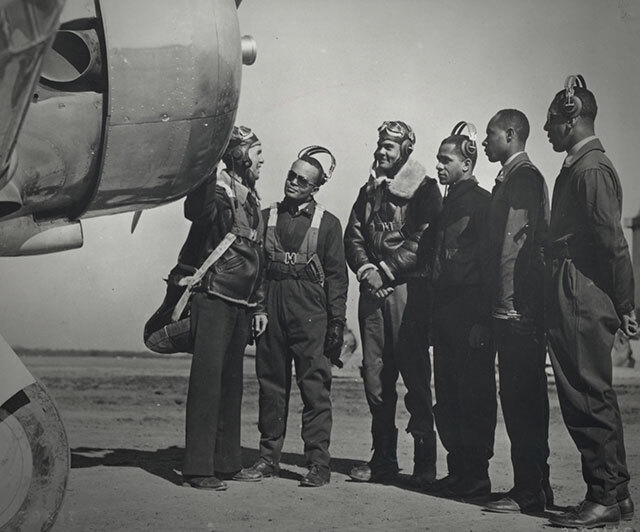
The group composed of the 99th Pursuit Squadron, 332nd Fighter Group, 477th Bombardment Group, and the 477th Composite Group was known as the “Red Tails,” and Stanton would’ve been familiar with them in the early 1950s. They became “Tuskegee Airmen” in May 15, 1955, in the pages of The Tuskegee Airmen: The Story of the Negro in the U.S. Air Force by Charles E. Francis.[5]
The story of the Red Tails, Stanton remembered, was a well from which he drew much inspiration especially during times of his own personal turbulence, such as the untimely passing of family members.[6]
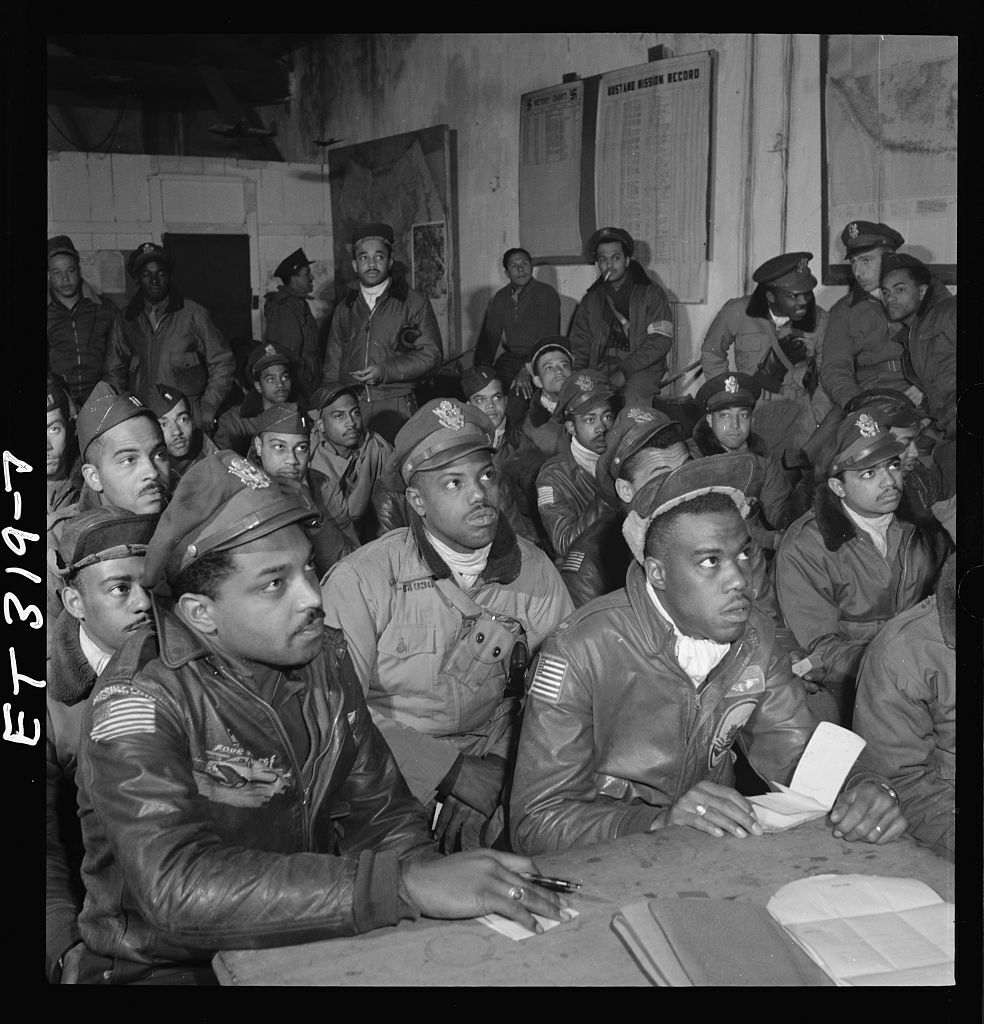
Following the outbreak of WWII and the increased American involvement, activists and community organizers saw the war as an opportunity to push the federal government to use its powers to provide equal rights for Black citizens. But the government was indifferent to the cause of Black Americans and kept to the status quo: separate but equal. Pressure from Black leaders and media, though, compelled the War Department to activate a segregated airfield and Black aviation unit on March 21, 1941 in Tuskegee, Alabama. The Tuskegee Airmen went on to fight in battles in the North African and Southern European theaters of war.
By the end of WWII, the Tuskegee Airmen had flown more than 15,500 defensive attacks and accomplished more than 1,500 missions. They successfully destroyed over 260 enemy aircraft and enemy ground installations, as well as an enemy destroyer. The Airmen earned some of the U.S. Army Air Corps’ highest military honors including the Distinguished Flying Cross, Legion of Merit, Silver Star, and Purple Heart. By 1948, more than 10,000 Black individuals received training as flight instructors, officers, fighter pilots, bombardiers, navigators, radio technicians, mechanics, air traffic controllers, instrument and weather forecasters, electrical and communication specialists, aircraft armorers, gunnery specialists, and parachute riggers.[7] These were decorated men of valor to whom Stanton could aspire.

The Airmen not only faced racial discrimination within the ranks of the Army Air Corps but also on the domestic front. By war’s end they faced a sad and daunting prospect at home: “not only the pleasure of [the air base at Tuskegee Institute/Moton Field] would end, but many of their jobs would be terminated.” Worse still “was the thought that after four years of war, Blacks had gained practically no respect and acceptance by whites,” and that the supreme law of the land upheld the segregation as a legitimate social convention.[8]
Heroics aside, veterans were subjected to beatings, torture, lynchings, false accusations, incarceration, hard labor, and dishonorable discharge.[9] The Tuskegee Airmen had to advocate and fight for equal status. Community leaders and the NAACP lobbied hard for investigations and justice for those veterans who had been wronged. They urged President Harry Truman to take decisive and corrective action. On July 26, 1948, after mounting pressure from the Black community, President Truman signed Executive Orders 9980 and 9981, which desegregated the civil service and the military.
Forty years after Truman’s historic executive orders, Stanton was serving as associate director of park operations at NPS headquarters when then-director William Penn Mott requested that the Southeast Regional Office conduct a preliminary study of Moton Field and Tuskegee Army Air Field for potential designation as a national historic landmark. The office found in February 1989 that the sites, indeed, were of national historical significance.[10]
Concerns around the Army Air Field soon arose when the regional office realized that many of the historic buildings had since destroyed, removed, or sat in general disrepair. As such, the regional office revoked eligibility for landmark status. Dr. Benjamin F. Payton, President of Tuskegee University, and Congressman Bob Riley of Alabama requested in 1997 that the NPS conduct a special resource study to consider preservation and management strategies for the sites.
The final report prompted Riley and fellow Alabama Congressman Earl Hilliard to introduce H.R. 4211 on July 14, 1998, for the purpose of establishing Tuskegee Airmen National Historic Site as a new unit of the NPS. President Bill Clinton on November 6, 1998 signed the bill establishing the site.[11]
The Tuskegee Airmen were pioneers, and their activism helped to desegregate the ranks of the military and thrust forward the civil rights movement. Their pioneering spirit surely captured Stanton’s imagination and he likely saw the Tuskegee Airmen as heroic figures and model Americans. When Stanton was deputy regional director of the Southeast Regional Office from 1974-76, he helped usher in new additions to the park system, including Tuskegee Institute National Historic Site. As Director of the NPS more than 20-years after that, and now part of the Clinton administration, he was excited and perhaps a bit relieved to welcome the Tuskegee Airmen National Historic Site into the park system fold. In 2004 he recalled, “It is almost unthinkable that as a nation we could fight our wars, but still felt we needed to be segregated because of our race. I mean, gosh, how much in the dark ages were we as a nation and as a people?”[12]
On the same day Clinton established the national historic site at Tuskegee, he also signed a law establishing Little Rock Central High School National Historic Site. As we’ll see, the Little Rock Crisis likewise had a profound impact on young Bob Stanton.
[1] Stanton, interviewed by Hamilton, session 2, tape 1, story 1.
[2] Office of the Quartermaster General, Application for Headstone or Marker, Cpl. Franklin T. Stanton, November 26, 1951, Prepared by AncestryLibrary. https://www.ancestrylibrary.com/imageviewer/collections/2375/images/40050_2421406273_0409-03357?usePUB=true&_phsrc=Oit1620&_phstart=successSource&usePUBJs=true&pId=1425974.
[3] Registration Card D.S.S. Form 1, Alvin Herbert Stanton. Serial No 102, Order No 657. October 16, 1940. Prepared by AncestryLibrary. https://www.ancestrylibrary.com/imageviewer/collections/2238/images/44040_10_00116-01755?usePUB=true&usePUBJs=true&pId=21092441.
[4] Stanton, interviewed by Hamilton, session 2, tape 1, story 11.
[5] Theopolis W. Johnson, “The Tuskegee Experience,” Tuskegee University. https://www.tuskegee.edu/Content/Uploads/Tuskegee/files/TuskegeeExperience(1).pdf.
[6] Stanton, interviewed by Hamilton, session 2, tape 3, story 3.
[7] Charles E. Francis, The Tuskegee Airmen: The Men Who Changed A Nation, Boston MA: Branden Books. 1993, 27–33; National Park Service. Tuskegee Airmen National Historic Site Foundation Document. U.S. Department of the Interior. January, 2017; National Park Service. Tuskegee Airmen National Historic Site General Management Plan/Environmental Impact Statement. U.S. Department of the Interior. 2010. 6.
[8] Francis, The Tuskegee Airmen, 210.
[9] Francis, The Tuskegee Airmen, 271-272.
[10] National Park Service, Moton Field/Tuskegee Airmen Special Resource Study, U.S. Department of the Interior. October, 1998, xii.
[11] National Park Service., General Management Plan/Environmental Impact Statement, 6-8.
[12] Stanton, interviewed by McDonnell, 47.
 The Sketch Book of Nick DeLuca
Leave a comment