
This is Part III in a multi-part series about the American West. You can read Part I here and Part II here. It probes our understanding and perceptions of the West as a historical place, or collection of places. It aims to get at the root of why we think about and portray the West the ways that we do. It also indulges the author’s personal fondness for the West.
By all accounts Phineas Lyman was respected across the Connecticut River Valley. His peers — the eligible voters of Suffield, Connecticut — elected him to several public offices. He served as town assessor, treasurer, and selectman, and as justice of the peace for Hartford County. He moderated town meetings, arbitrated boundary disputes, negotiated public leases, and laid out roads. He earned additional income as a lawyer and owned a partial stake in a corn mill.[1] He also saw action in the French and Indian War, rising to the rank of major general in the Connecticut militia. He married Eleanor Dwight of Northampton, Massachusetts and she bore him eight children, six of whom survived to adulthood. It seems he did everything right. Why he felt he needed more, we can’t be certain. What we do know for certain is he would go on to found the Company of Military Adventurers in search of land and riches in the West.[2]
We also know that open land in mid-18th-century Connecticut was increasingly scarce. Hemmed to the coast as it was by New York and New England, the colony’s growth potential was restricted. To find a solution, speculators and land companies turned to the 1662 Royal Charter of Connecticut. The language of the charter suggested that all land stretching across the continent from Narragansett Bay to “the South sea [Pacific Ocean]” belonged to the Colony of Connecticut — it didn’t matter that the Crown had an imprecise and problematic understanding of North American geography and cultural diversity.
Speculators and prospective settlers interpreted the charter to mean that the land on the other side of New York — land known as the Western Reserve[3] — was a rightful part of Connecticut. But Pennsylvania staked a claim to the land on the other side of New York. Inter-colonial border clashes ensued, as did conflicts with local Indigenous peoples. As more and more fighters and settlers entered Northeast Pennsylvania, speculators incorporated land companies and began to buy up plots in the Wyoming Valley.
Phineas Lyman was among them.
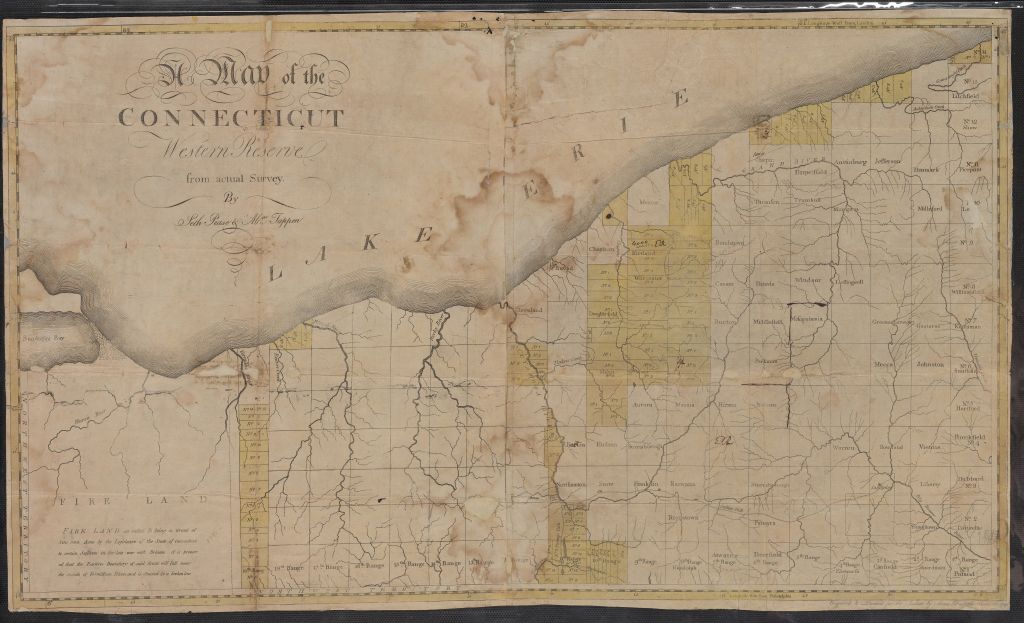
In January 1754, Lyman invested “five dollars” to become a shareholder in the Susquehanna Company, an organization of investors from the Northeast with sights set on the Wyoming Valley. That summer the company made its first real estate deal and secured from a delegation of Iroquois “a large tract of land on about and adjacent to the River Susqueannah between the fourty first & fourty third degrees of north latitude… within the limits and bounds of the charter and grant of his late Majesty King Charles 2nd” for the price of 2,000 British pounds.
Lyman’s experience as an arbitrator and reputation as a Connecticut gentleman earned him executive roles in company leadership. He used his position to negotiate deals with Iroquois and Pennsylvania agents alike, and to petition the King for a royal charter for the company. A royal charter would give legitimacy, credibility, and security to the company as both a colony- and Crown-sponsored organization.
Lyman began selling his company shares in 1755. By then it appears he had acquired an additional share, for after he sold one share to Joseph Pease for “nine dollars in full,” he later sold half a share to Ennice Ely for “four & a half dollars.” The deal between the Susquehanna Company and the Iroquois may have been Lyman’s first major business transaction, and may have ignited his penchant for real estate. The profit he made from dumping his stock may have contributed to this attitude as well. And as we’ll see, even during wartime he recognized a good business opportunity when he saw one.
The British declared war on the French in the 1750s, kicking off the so-called French and Indian War in North America. At this time, Lyman was among the most experienced militia officers in New England. He rose through the ranks of the Connecticut militia from major to colonel and eventually to major general, and he commanded troops at the battles of Lake George, 1755; Carillon, 1758; and Crown Point, 1759. He later participated in the Montreal campaign in 1760 and British siege of Havana in 1762.
The British captured Fort Ticonderoga in 1759 with much credit due to Lyman. On November 10, while still camped near the fort, Lyman and fellow officers from the Connecticut and Massachusetts Bay militias submitted a petition to Lord Jeffrey Amherst, commander-in-chief of all British forces on the continent. The officers hoped to secure a tract of land abandoned by the French that extended south of the fort along a developing road. The land would “not be of much Value,” they told Amherst, “unless Inhabited.” They asked Amherst for “leave to Offer Our further Service for the Settlement of a Township, by each Battalion.”
The officers claimed this was also a surefire way to prevent “Incursions of the Indians into Our Country.” They asked Amherst to put their request before the King, and that if “His Majesty would be graciously Pleased to make Grants,” they would be happy to “facilitate the Settlement.”[4]
The campaigns of the late 1750s and early 1760s secured for the British complete control of Canada. In 1762 the British commenced military operations to seize Havana, Cuba from the Spanish. The Colony of Connecticut raised two regiments and placed Lyman at the head of one of them.

Havana was the crown jewel of the Spanish Caribbean and it was well defended. The imposing Castillo del Morro overlooked the port of Havana from the cliffside. It was a difficult enough mission for the British to dislodge the Spanish from this stronghold, but it was further complicated by tropical diseases like yellow fever. Almost 30,000 combined British land and naval forces descended on Havana. Disease was responsible for over 90 percent of the more than 5,000 British casualties. The siege was monthslong and the British would occupy Havana for almost a year.
The city’s capture was a strategic victory for Great Britain and gave them leverage over the Spanish to negotiate ownership of the Floridas. The siege also introduced Lyman to tropical environments and the ravages of disease. It may have been while in Cuba that he first heard about the fertile Mississippi Delta. That area, after all, was also under Spanish control. It’s not outside the realm of possibility that he encountered people with first-hand experience of the Delta, or, just as likely, people who had heard stories of it second hand. When the war was over, Lyman returned to Connecticut where he contracted smallpox. While he nursed his health, he may have also nursed a growing discontent with British public service.[5]
The Company of Military Adventurers was incorporated in 1763 shortly after Lyman arrived in Connecticut. The origins of the company are a bit dicey because the historical record is spotty. We have to rely on historian Albert C. Bates, who edited a compilation of Connecticut militia journals and logs, and transcribed some notes from some company meetings that no longer seem to exist.
If the original stockholders of the company held an inaugural meeting, their only business may have been to send Lyman to England to lobby the government for a royal land grant on their behalf. Or, Lyman may have undertaken this mission on his own accord. Whatever the circumstances, in 1763 Lyman set sail for England. Unbeknownst to him, he would spend the next decade trying to garner the attention and support he probably thought he deserved.
Lyman got right to work in London. He was already comfortable as a lobbyist, having served as one for the Susquehanna Company. He was also comfortable corresponding with imposing public figures like Amherst and Robert Monckton, two of the highest ranking British officers in North America. He proceeded to fire off petitions, memorials, and letters to the biggest players in the game on both sides of the Atlantic and on both sides of the political spectrum: Rev. Eleazor Wheelock; William Petty, 2nd Earl of Shelburne; William Legge, 2nd Earl of Dartmouth; Wills Hill, 1st Marquess of Downshire, and 1st Earl of Hillsborough; the Privy Council; and King George III, to name just a few. It was all to no avail.

Historians like Bates have characterized Lyman’s failure to secure a land grant for the company as a snub.[6] They say given his service and reputation, he was deserving, at the very least, of an audience to plead his case. This may be true, at least in part, but it overlooks other major socio-political swings of the time. There are other possible reasons why Lyman’s efforts fell on deaf ears.
First, the American Revolution was fully underway. The British government was trying to navigate how to impose revenue-generating measures of taxation on its colonial holdings without further inflaming rebellious activity in major shipping outposts like Boston. In February 1766, Lyman wrote a letter to Governor Thomas Fitch of Connecticut referring to the Stamp Act of 1765, which incited violent riots on the streets of Boston, as “that odious act.” He hoped most of all that if and when the act were to be repealed, the government would commence in “beneficial plans to Enlarge the Trade of America,” which surely to him meant colonization.[7] The government’s priorities to address the Revolution meant Lyman’s requests would have to wait.
Second, an emerging problem in Parliament sucked up what was left of the political oxygen in the House of Commons. Radical Middlesex MP John Wilkes was elected but removed from the House, only to be re-elected multiple times after. This sparked a larger controversy about democracy and the rights of electors in England. From London, the merchant Dennys De Berendt wrote to Thomas Cushing, speaker of the Massachusetts General Court, explaining that Massachusetts petitions submitted to the King were likely to get lost in the shuffle of “chusing Members for Parlia[ment],” which, De Berendt added, “Genl Lyman being there at my house agreed with me in that opinion.” The controversy, known as the Middlesex Election Affair, combined with the Revolution in North America, pulled the attention of the British government towards issues of democracy and liberty both at home and abroad. Lyman seemed to recognize that the affair was an obstacle that stood in the way of any petitioner, himself included.

Third, other colonists had been making representations to the government that portrayed West Florida in a less favorable light than Lyman had. One such letter, for example, from a Mr. Oldham of West Florida to the Earl of Dartmouth “describes the country for many miles round Pensacola as utterly incapable of cultivation, nor is it possible for the troops to procure vegetables however industrious they may be, the fatal consequence of which has been the total destruction of the 35th Regiment. Scarcity of other provisions.”
At the same time that the Board of Trade was hearing conflicting reports of the environment of West Florida, British colonial agents were negotiating the 1768 Treaty of Fort Stanwix. The treaty clarified boundaries between the Iroquois and British colonies. The Board Of Trade disapproved of the stipulations within the treaty, and even cited Indigenous boundary disputes as a reason for turning down Lyman’s request for land in the West. To the Board of Trade, West Florida was a hostile environment full of hostile Indians. For a while, Lyman was unable to convince them otherwise. He was a man accustomed to commanding peoples’ respect, one whose thoughts were always given due consideration. He often found himself in power dynamics that lent gravity to his abilities to negotiate, and he often got what he wanted. Now, Lyman found himself in the unusual position of being powerless to get anyone to share in his vision.
Still, he persisted. His efforts were so exhaustive that even Benjamin Franklin took notice. Franklin’s son William was involved in a project to colonize the Illinois Country. Writing to William in September 1766, Franklin observed that while William’s plans for settlement were sound, support for it in Parliament was waning. Franklin wondered if Lyman, “long here soliciting such a grant,” might combine efforts with William and “readily join the interest he has made with ours.” The following year, though, Franklin wrote to William again, noting “The Ilinois affair goes forward but slowly… Lyman is almost out of patience, and now talks of carrying out his settlers without leave.” As the 1760s came to a close, Lyman was at his wit’s end.
He caught a small break in 1769. At long last Lyman managed to secure an audience with the British Board of Trade. He finally had a chance to state his case. He may have felt confident in his abilities to sway the Board. After all, he had achieved at least regional acclaim as a New England lawyer and litigator. Outside of commanding men on the battlefield, this is the kind of situation in which Lyman shined the brightest.
But surely to his surprise and chagrin, the Board “could form no resolution with regard to any proposition for making grants of lands” for his purpose.
It appears, though, that in 1770 the Board had a change of heart. In March it published a representation for granting Lyman 20,000 acres in West Florida. This was essentially an endorsement but it carried no legal weight. The Board at times may have been able to sway the king and House of Lords, but not this time. Though the Board supported Lyman’s request for land, there’s no evidence the king ever signed a royal charter or proclamation granting those lands to Lyman or the Company of Military Adventurers.
In 1772 he returned to Connecticut and to prepare for the Military Adventurers’ West Florida Expedition — with or without a royal grant.
Part IV to follow.
[1] It’s worth noting that Joseph Hawley of Northampton studied law under Lyman. Hawley would become the most vocal radical from the western part of Massachusetts Bay Colony during the American Revolution. He often worked with Samuel Adams to foment rebellion in the House of Representatives.
[2] Lyman can be difficult to pin down in the historical record. While his public life is pretty well documented given his service as a civil and military officer, his personal life is rather vague. To understand Lyman’s motivation for forming the Company of Military Adventurers to settle the Mississippi Delta of British West Florida, we need to rely on context clues and informed speculation.
[3] Hence places with names like Case Western Reserve University in Cleveland, OH. (Place-name origins are fun!)
[4] I have not been able to identify evidence that Amherst ever put this petition before the king, but that’s not to say it didn’t happen.
[5] Historian Albert C. Bates said Lyman declared an “almost unconquerable dislike… entertained against any Service in the hot Climates” by the militia forces, suggesting a growing dissatisfaction among provincial troops and Lyman specifically. Bates also asserts the seeds of discontent were planted when the prizes and plunder of Havana were divided and individual shares were smaller than anticipated. I have not been able to identify any evidence to back up these quotes and claims.
[6] I don’t think the Board snubbed Lyman per se. In fact, they went on record in 1770 as being “fully sensible of the merit of his services, and should be glad of any occasion of testifying that sense of it.” They also granted him an in-person audience and entertained several petitions and memorials. They even wrote a representation supporting at 20,000 acre grant for Lyman. For years they simply had larger issues to deal with and Lyman was not a priority.
[7] Lyman’s posture on the Stamp Act seems to suggest that while he opposed the act, he hoped its repeal would instill a sense of gratitude in the colonies and inspire loyalty to the Crown. He may have struck this moderate tone to try and advance his own plans without repercussions from the revolutionary activity at home. He may have also truly had sympathy for both sides of the cause.
 The Sketch Book of Nick DeLuca
Leave a comment