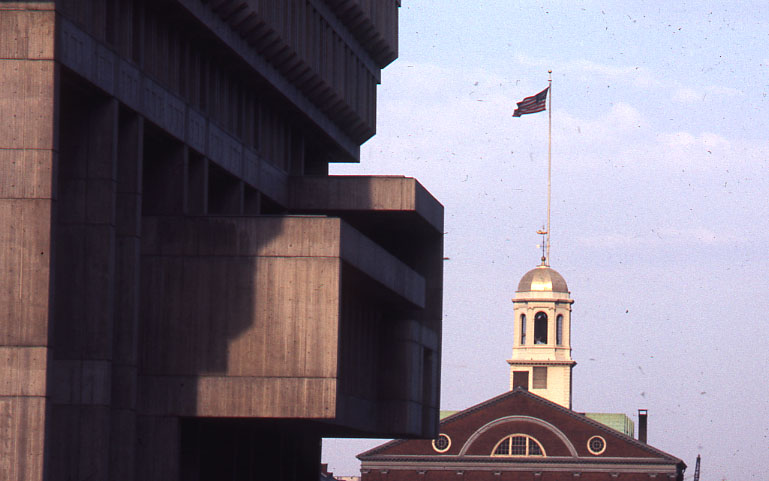
On June 8, friends and family of longtime Massachusetts Congressman Barney Frank gathered at Faneuil Hall for his funeral. Frank, 86, died on May 19 at his home in Ogunquit, Maine. He is the latest individual to be honored at Faneuil Hall since Tom Menino, the longest serving mayor in Boston history, lay in state there in 2014 (which was the first such occasion since the 1800s).
For centuries, Bostonians have bestowed commemorations on important deceased people at Faneuil Hall but it wasn’t always political figures. The reasons and context for those commemorations have changed over time. Frank’s funeral offers us an opportunity to examine this history and better understand the nuances of the building’s past. How and where we honor our dead tells us much about who and what we value in the present moment.
Death has been a part of Faneuil Hall since the building’s earliest days. The hall was conceptualized, funded, and donated to the Town of Boston by merchant Peter Faneuil in May 1740. In September 1742, with construction of the hall complete, the freeholders of the town voted to accept Faneuil’s gift, name it after him, open it for municipal administration and marketplace activity, appoint a market clerk, and decorate the interior with portraits of Faneuil and King George II. But Faneuil hardly witnessed the hall as the center of Boston commerce and political action it would soon become. The freeholders held a single town meeting at Faneuil Hall in December 1742 before Faneuil died in March 1743. The next public event at Faneuil Hall was a memorial service for its namesake.
Faneuil’s memorial set a pattern. When Faneuil was eulogized by John Lovell more than 20 years prior, Lovell emphasized Faneuil’s philanthropy. Indeed, Faneuil gave to charitable causes, various houses of worship, and, of course, civic institutions. “It was to him the highest Enjoyment of Riches,” said Lovell, “to relieve the Wants of the Needy… to see Mankind rejoicing in the Fruits of his Bounty, and to feel that divine Satisfaction which reſults from communicating Happiness to others.”

At no other town meeting did the freeholders of Boston commemorate the life of a fellow inhabitant until the August 1764 death of Thomas Hancock, the wealthy uncle of future revolutionary John Hancock. Bostonians gave Hancock the same treatment as Faneuil. They voted and affirmed “that the Name of Hancock be Recorded and enrolled among those of Faneuil and the other worthy Benefactors of this City.” Then they established a committee to raise money to build a hospital that “when erected shall be called and known by the name of Hancocks Hospital.” From the 1740s through the 1760s, the town only honored two deceased Bostonians at Faneuil Hall and both were the wealthiest and most charitable of their time and place. (Both men, however, were intimately connected with the Atlantic slave trade.)
This pattern of honoring the town’s great benefactors was short-lived, however, as it was interrupted by the American Revolution.
When the British Parliament passed taxation legislation in the 1760s and 1770s, Bostonians responded by physically harming customs officers and tax collectors and destroying their property. Thousands of British soldiers were sent to quell the violence. Tensions between the military and the townspeople boiled over; on March 5, 1770, they erupted.
That evening, British sentries stationed outside the custom house discharged their firearms into a crowd of Bostonians. They killed five people. The so-called Boston Massacre became a major element of the rebel cause and was deployed as propaganda by the colonial patriots to try and sway fellow colonists to their side. They used exaggerated language and imagery to depict the British soldiers as ruthless killers and King George III as a tyrant bent on enslaving the colonial population.
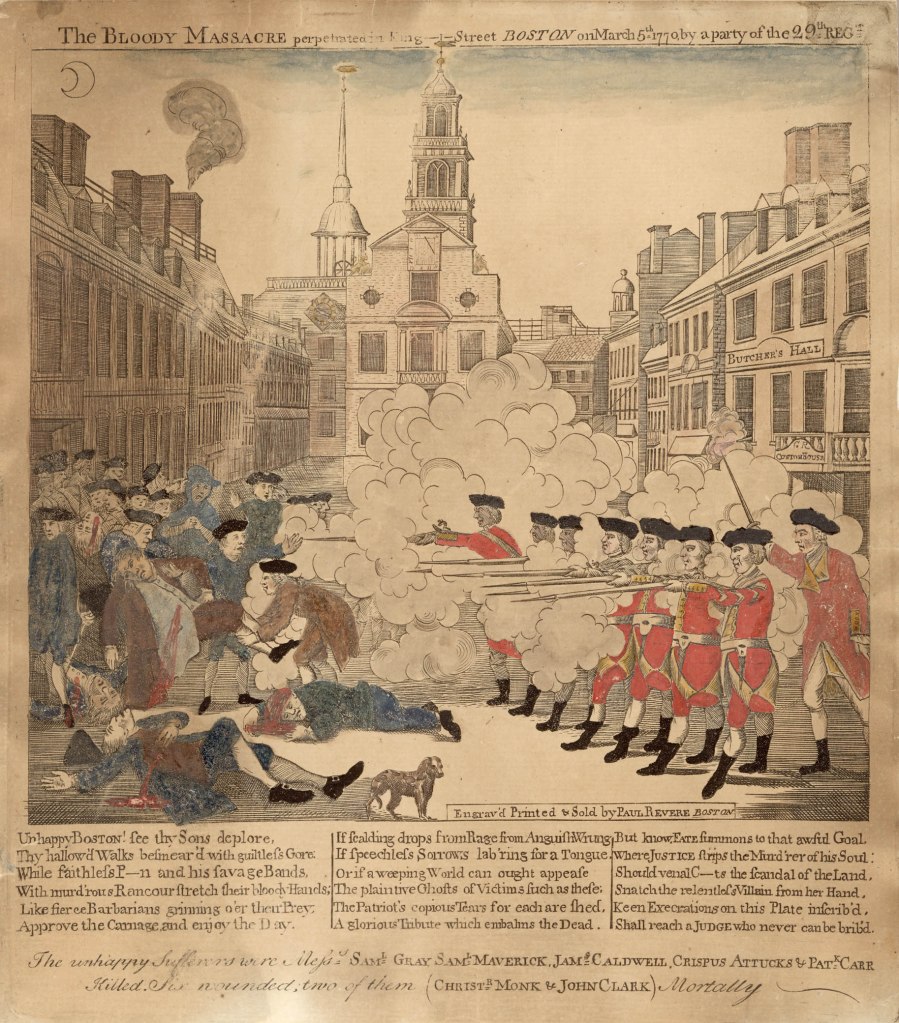
As part of this propagandization, radical organizations like the Sons of Liberty used Faneuil Hall to stage a place of mourning for Massacre victims James Caldwell and Crispus Attucks. This tribute was “attended by a numerous Train of Persons of all Ranks.” They also arranged for a massive funeral procession for fellow victims Samuel Gray and Samuel Maverick “in King Street [today’s State Street], the Theatre of the inhuman Tragedy… lengthened by an immense Concourse of People, so numerous as to be obliged to follow in Ranks of fix.” The American Revolution transformed Faneuil Hall as a venue for remembering the lives of the merchant class into a space for honoring martyrs of the patriot movement.
After the Revolution, the budding United States saw its founding generation age out of power. Their inheritors understood that the young country had little national history and they used death as an occasion to create a cultural identity. The dual deaths of John Adams and Thomas Jefferson on July 4, 1826 provided a moment for exactly that.
On August 2, Daniel Webster held forth at Faneuil Hall to eulogize Adams and Jefferson, two architects of the Revolution who both happened to die on the 50th anniversary of the Declaration of Independence. In doing so, Webster elevated the ranks of people memorialized at Faneuil Hall from local to national figures. His oration fused together fact and fiction: Webster actually invented a debate between an opponent of the Declaration and Adams, who stuck up for the document written predominantly by Jefferson. Webster also acknowledged, but glossed over, the political disagreements between the two, saying it was “not the time, nor this the occasion, for entering into the grounds of that difference.”
Webster’s speech catapulted him into the stratosphere of American orators. He became a national celebrity and, by extension, his eulogy became a cultural sensation. All of these factors — the deaths of Adams and Jefferson on the Fourth of July, the dismissal of their political differences, the setting at Faneuil Hall, Webster’s oratorical powers, and the wide circulation of his eulogy — presented a romanticized version of the American past and instituted a new pattern of paying respect to eminent statesmen at Faneuil Hall. This continued in 1834 and 1848 when Edward Everett eulogized the Marquis de Lafayette and John Quincy Adams, respectively. In 1865, the City of Boston memorialized Everett, too, at Faneuil Hall with resolutions, remembrances, and the hanging of his portrait.

In the 19th century, Faneuil Hall was a central meeting place in New England for social change leading up to, during, and following the US Civil War. Bostonians started to replace honoring statesmen with honoring reformers.
In February 1884, abolitionist and orator Wendell Phillips died. In addition to “the simplicity of the exercises and the quiet demonstrations of public respect,” Phillips lay in state at Faneuil Hall where he “was placed in front of the rostrum, from which the dead orator had so often spoken words that burned to the great assemblies of the public.”
Frederick Douglass died more than a decade later in February 1895. Brilliant, eloquent, and intimately familiar with the horrors of slavery, Douglass spoke out against the institution of slavery at Faneuil Hall over a dozen times. In December, the City of Boston hosted a tribute to Douglass at Faneuil Hall where an “immense audience” of “people of all races and classes were represented.” Newspapers reported it was “the first time in the history of Boston” that “a memorial service had been held at the instance of the city government in honor of a colored man.”
This trend continued into the 20th century. In 1909, Bostonians observed the 50th anniversary of the death of militant abolitionist John Brown. Brown was captured under the command of future Confederate general Robert E. Lee after his 1859 raid on the federal arsenal at Harpers Ferry, Virginia failed. He was charged with, and found guilty of, murder, treason against the Commonwealth of Virginia, and conspiracy to foment a slave insurrection.
His trial and execution became national spectacles, and for many Northerners he emerged as a martyr to the antislavery cause. Fifty years later, “Faneuil hall rocked” for John Brown’s memory. Speakers included activists, clergy, and military members. Organizers placed a bust of Brown inside the hall and even displayed building materials from the Harpers Ferry guard engine house from which Brown launched his raid.
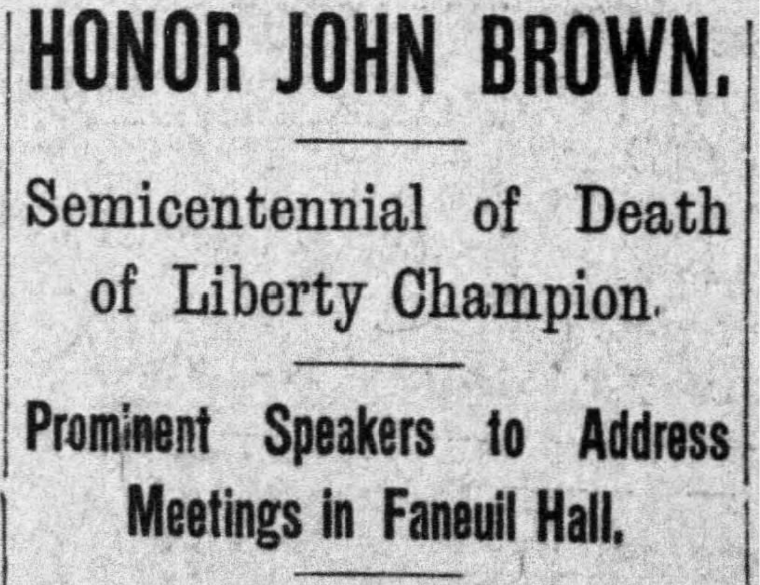
Faneuil Hall was “packed to suffocation” and attendees were forced out onto the stairs and sidewalk. “Black and white men, women and children flocked to the historic hall to commemorate the man whom a great part of the American race consider almost their savior.”
Following the event for John Brown, memorials and commemorations for the dead at Faneuil Hall dwindled. Faneuil Hall became less a place for memory- and myth-making and more a place for civic and political engagement: anti-war protests, labor disputes, women’s reproductive rights, LGBTQ rights, environmental activism, and more. But when the US government authorized Dr. Martin Luther King, Jr. Day as a federal holiday in 1986, Bostonians started hosting annual celebrations in honor of the civil rights activist.
Posthumous observances at Faneuil Hall were quite uncommon until Menino in 2014 and now Frank. This is telling. Menino was a local who served at City Hall longer than any other Bostonian. He gained favor with community members and neighborhood groups and left office with tremendous popularity. Likewise, Frank was a longtime advocate for marginalized communities in and around Boston. As a Congressman from 1981-2012 and Chairman of the House Financial Services Committee, Frank was a heavyweight who wielded significant political influence and generated great admiration in New England.
The long arc of death and mourning at Faneuil Hall reveals who Bostonians have deemed worthy of tribute and the characteristics they personify. Of course, noticeably absent from this pantheon are women while people of color remain largely underrepresented. Faneuil Hall has honored merchants, revolutionaries, presidents, civil rights advocates, and elected officials. Barney Frank’s funeral is the latest iteration of that tradition—not because he was universally admired, but because Boston has increasingly chosen to commemorate people whose significance lies not only in power or wealth, but in their role in expanding the boundaries and rights of American civic life.


Leave a comment